
Books
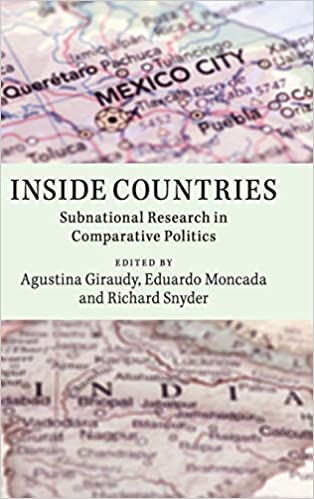
Inside Countries
2019 · Cambridge University Press
Although comparative politics is traditionally understood as the study of politics across countries, the field has a longstanding — and increasingly influential — tradition of examining politics within countries, focusing on subnational units, institutions, actors, and processes. This book provides the first comprehensive assessment of the substantive, theoretical, and methodological contributions of this subnational turn in comparative politics.
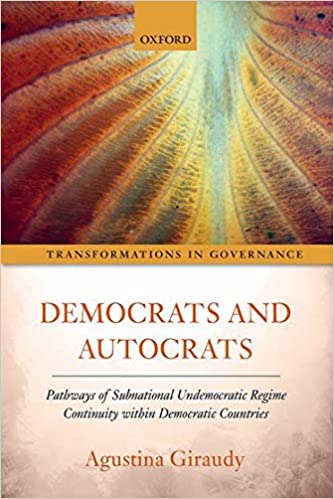
Democrats and Autocrats
2015 · Oxford University Press
Even though many Latin American countries transitioned to democracy, large segments of their populations — particularly those living in peripheral regions — continue to experience undemocratic rule. This book examines the persistence of subnational undemocratic regimes in Argentina and Mexico, identifying multiple within-country trajectories that explain how and why such regimes are reproduced.
Subnational Politics Project

The Subnational Politics Project (SPP) is a collaborative initiative dedicated to compiling, generating, and disseminating systematic, transparent, and publicly accessible data on subnational political institutions, processes, and electoral outcomes across Latin America.
The SPP's central goal is to build a comprehensive and standardized data infrastructure that enables both detailed within-country analysis and robust cross-national comparisons of subnational political dynamics.
By providing consistent and high-quality data, SPP seeks to advance scholarly and policy-oriented research on the political foundations and consequences of territorial inequality in the region.
Research
Pathways of Subnational Undemocratic Regime Erosion: Varieties of Federalism in the Americas
Kent Eaton & Agustina GiraudySubnational Undemocratic Regimes in the Americas: Argentina, Brazil, Mexico, and the United States in Comparative Perspective
Kent Eaton & Agustina GiraudyWhat Can Latin America Tell Us about Subnational Democratic Erosion in the United States?
Kent Eaton & Agustina GiraudyDigging deeper: Unpacking the subnational political drivers of Chinese extractive investment in Latin America
Agustina Giraudy, Francisco Urdinez and Andrea FreitesFrom international organizations to local governments: how foreign environmental aid reaches subnational beneficiaries in Argentina, Brazil, and Mexico
Isabella Alcañiz & Agustina GiraudyPodcasts

Original Podcast
UPROOT
UPROOT is a space for stories of movement, belonging, and reinvention. In each conversation, I speak with people who have left their home countries and started anew in the United States. Together, we talk about what it means to feel uprooted — and to grow new roots.
In the Media
Data
Democrats and Autocrats: Pathways of Subnational Undemocratic Regime Continuity within Democratic Countries (2015)
Who Wants an Independent Court? Political Competition and Supreme Court Autonomy in the Argentine Provinces (1984-2008) (2015)